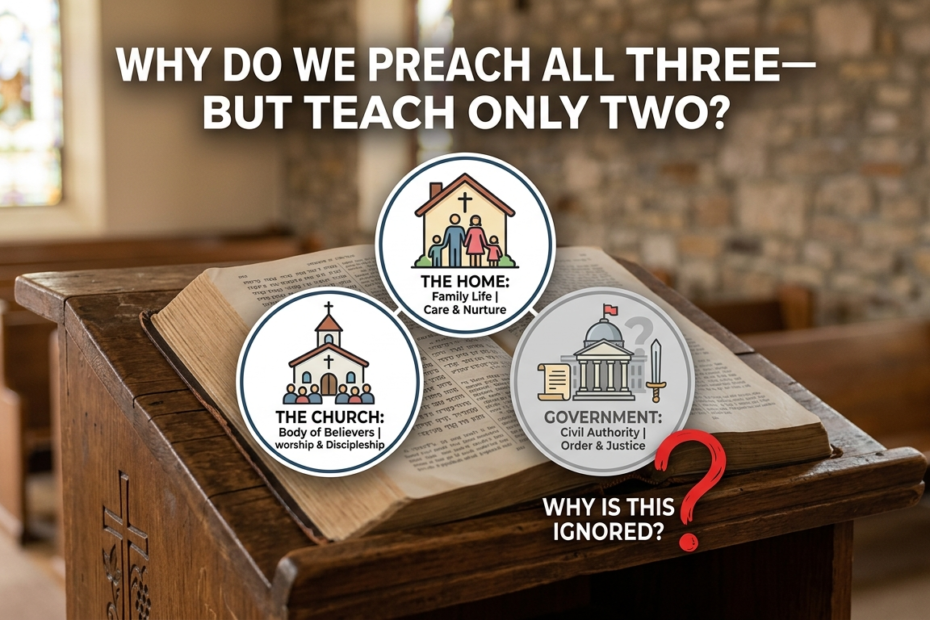
Why Do We Preach All Three—But Teach Only Two?
Many pastors will confidently say:
“God ordained three institutions—the home, government, and the Church.”
That statement is familiar in Baptist churches across rural Indiana. It reflects a long‑held Christian understanding that God works through family life, civil authority, and the body of believers for order, protection, and moral guidance.
Yet in practice, something curious often happens.
The home is preached and taught often.
The Church is preached and taught constantly.
But government, though named, is frequently avoided.
The Church is preached and taught constantly.
But government, though named, is frequently avoided.
Why is that?
A Real Tension We Should Acknowledge
One honest answer may be this:
Government in the Bible and government as experienced in the United States are not the same thing.
Government in the Bible and government as experienced in the United States are not the same thing.
The Bible speaks to:
- Kings and judges
- Empires and pagan rulers
- Nations shaped by covenant and conquest
Our American system is different—constitutional, representative, layered with courts, states, and agencies. What applied directly to ancient Israel or Rome cannot simply be copied and pasted onto modern nations, let alone exported to the rest of the world.
That difference is real, and pastors are right to be cautious.
But caution is not the same as silence.
Principles Are Not Parties
Scripture may not give us a modern policy manual—but it does give us principles:
- God establishes authority
- Rulers are accountable to Him
- Government is meant to restrain evil and promote justice
- Obedience has limits when God is contradicted
- God’s people must know how to live faithfully under authority
Teaching these truths does not require endorsing a political party, a candidate, or an election outcome. It requires something harder:biblical clarity without cultural fear.
Avoiding government entirely doesn’t keep the church united—it leaves believers to be taught by television, talk radio, and social media instead of Scripture.
Silence Has Consequences
When churches don’t teach on government at all:
- Young people assume the Bible has nothing to say about public life
- Older believers feel forced to separate faith from daily realities
- Political opinions are formed without biblical framework
Government still disciples people.
The question is whether the church will help interpret it biblically or stay silent while something else fills the gap.
The question is whether the church will help interpret it biblically or stay silent while something else fills the gap.
Teaching Is Not Campaigning
No one is asking for:
- Campaign speeches from the pulpit
- Political signs in the sanctuary
- Churches becoming voting blocs
But if God truly ordained three institutions, then neglecting one of them creates an imbalance in Christian understanding.
Teaching government means:
- Explaining what Scripture actually says
- Acknowledging what it does not say
- Helping believers think, not telling them how to vote
- Forming consciences rather than controlling conclusions
That kind of teaching strengthens the church—it doesn’t divide it.
A Call for Whole‑Bible Teaching
This isn’t about being “political.”
It’s about being biblical.
It’s about being biblical.
If God ordained:
- The home
- The Church
- Civil government
Then faithfulness requires that we teach all three, carefully, humbly, and honestly—especially in confusing times.
Avoiding a subject the Bible speaks to does not preserve unity; it weakens discernment.
Final Thought
Perhaps the question is not whether pastors should teach on government, but how—with Scripture first, fear last, and trust that truth, when handled rightly, still sets people free.