Skip to content

church leadership

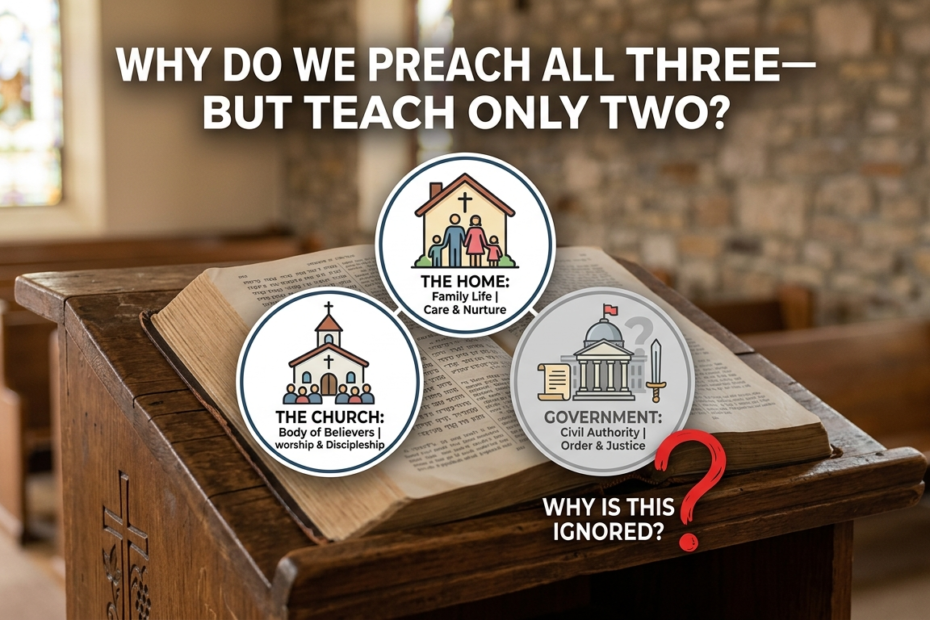
An open Bible on a church pulpit featuring an infographic with three circular icons: The Home, The Church, and a grayed-out Government icon. Large text at the top asks, "Why do we preach all three—but teach only two?" A large red question mark sits by the Government icon.

Whole‑Bible Teaching and the Institution We Avoid

God ordained three institutions: the home, the church, and civil government. Yet, while the first two are preached constantly, the third is frequently avoided out of fear or confusion. Staying silent doesn’t preserve unity—it simply allows culture, talk radio, and social media to disciple believers instead of Scripture. Here is why the church must break its silence and learn how to teach biblical principles of government without turning the pulpit into a political campaign.
Open Bible with glasses and coffee beside symbols of authority, representing biblical discernment and respect for authority

Authority, Respect, and Biblical Discernment

  • by

Many are taught to “respect the position” without question—but is that biblical? This post explores the balance between honoring authority and maintaining God-given discernment.

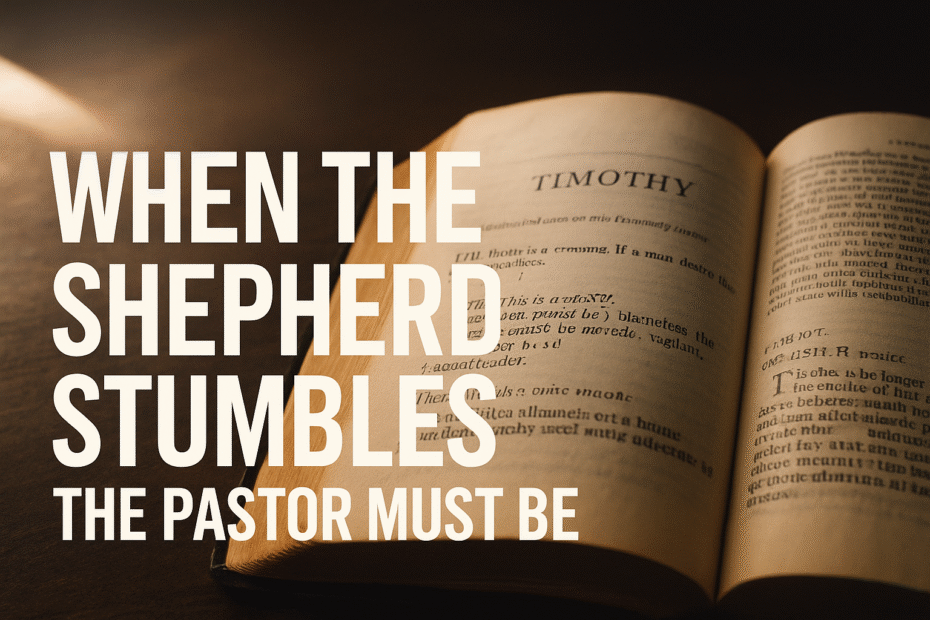
Open Bible showing 1 Timothy 3 in warm light with bold text reading “When the Shepherd Stumbles — The Pastor Must Be.”

The Present-Tense Pastor (KJV Truth Study)

  • by

The KJV reminds us that a pastor’s characteristics are present tense, not past. When a shepherd no longer “must be” what Scripture says, the church must respond with truth, grace, and the courage to restore or release.

faithfulness-over-frequency-sunday-services

Sunday Services and Church Schedules: Faithfulness

  • by

Many pastors feel pressured by changing service schedules. But Scripture never commands how often we meet—only that we gather faithfully. Whether your church meets once or three times a week, Christ—not the calendar—defines faithfulness.