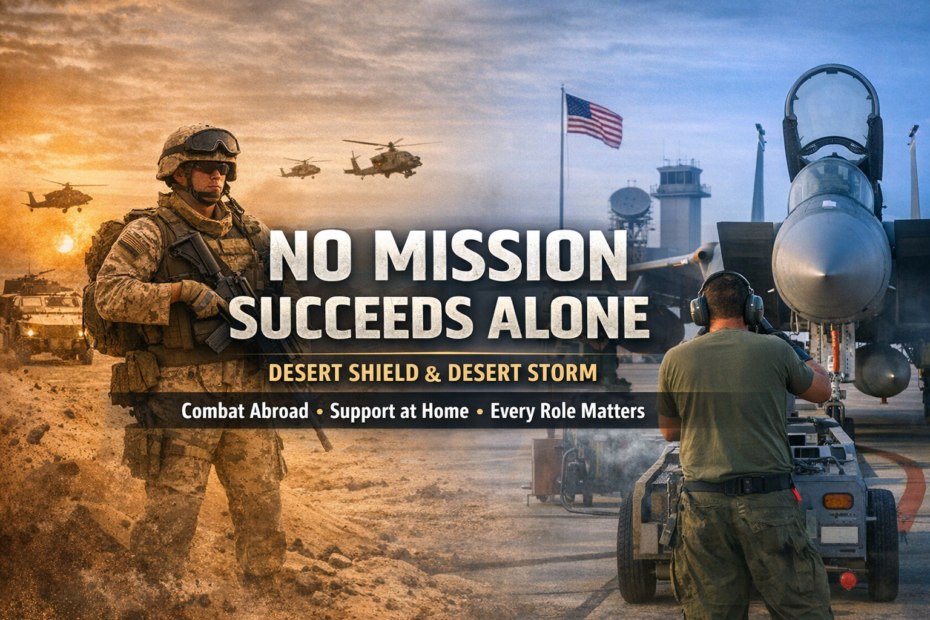
Why Every Role—Abroad or Stateside—Mattered During Desert Shield and Desert Storm
Within the veteran community, there is sometimes an unspoken divide—one based not on service, but on where that service took place. Overseas versus stateside. In‑theater versus support.
That divide has never sat right with me.
Not because combat doesn’t matter—it absolutely does—but because no foreign war has ever been won without a functioning support system behind it.
And Desert Shield / Desert Storm was no exception.
A Mission Is More Than the Tip of the Spear
Every veteran understands mission success. We’re trained to think in systems, not in isolation.
During Desert Shield and Desert Storm, success required:
- Forces ready to deploy at a moment’s notice
- Secure bases and installations at home
- Logistics, maintenance, supply, and communications working without failure
- Intelligence flowing accurately and quickly
- Medical, administrative, and training pipelines holding steady
- Families absorbing strain so service members could stay focused
Remove any one of those, and the entire operation falters.
Combat forces cannot move forward if the foundation behind them collapses.
Stateside Did Not Mean Irrelevant
Many service members—especially those already in uniform since the 1980s—served during Desert Shield:
- On heightened alert
- In security‑sensitive and mission‑critical roles
- Preparing for rotations that never came because the ground war ended quickly
That outcome wasn’t a reflection of their value.
It was a reflection of how efficiently the system worked.
The speed of the ground campaign was made possible precisely because the support structure was already in place and functioning.
Combat Deserves Honor—So Does Readiness
This message is not about diminishing combat service.
Those who deployed faced real danger.
Some carry wounds that never healed.
Their sacrifices deserve full respect.
But respect is not a finite resource.
Readiness, preparation, and sustained support are not “lesser” forms of service. They are the reason combat units can fight, survive, and return home.
In military terms, the tip of the spear is only effective if the shaft behind it holds.
When We Rank Service, We Miss the Point
When veterans begin ranking one another by geography or medals, something gets lost.
The oath was the same.
The mission was shared.
The risk—while different in form—was real for everyone involved.
War is not an individual achievement.
It is an organizational one.
A Message Both Sides Can Stand On
Whether your boots landed overseas or stayed on U.S. soil during Desert Shield and Desert Storm, one truth remains:
The mission could not have succeeded without you.
Foreign wars fail without support systems.
Support systems exist because people serve—often without recognition, cameras, or medals tied to location.
That is not a weakness in their service.
That is the strength of a functioning force.
Moving Forward as One Veteran Community
We don’t honor our service by dividing it into tiers.
We honor it by recognizing that:
- Combat and support are inseparable
- Success is shared
- Service is service
When we understand that, we don’t lose anything—we gain perspective, unity, and the ability to heal old, unspoken wounds.
And that, too, is part of the mission.