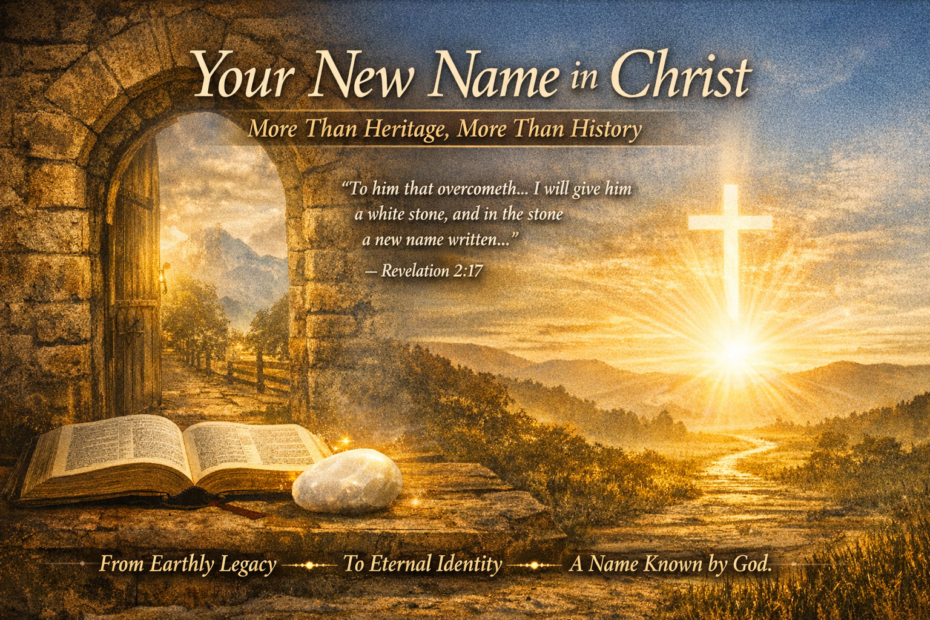
Your New Name in Christ: More Than Heritage, More Than History
Names matter. They always have. Our earthly name ties us to a family, a heritage, a story. It hints at where we came from, what our people did, and the voices we learned to trust. A surname can whisper of old trades — Smith, Miller, Carpenter — reminders of what our hands once did. A given name often carries the hopes of parents, the traditions of a family, or the memory of someone loved.
But Scripture tells us something remarkable: In Christ, a new name awaits us. A name not shaped by our past, our failures, our lineage, or our earthly story — but by Him.
The Promise of a New Name
Revelation 2:17 says: “To him that overcometh… I will give him a white stone, and in the stone a new name written, which no man knoweth saving he that receiveth it.”
This new name is personal. Intimate. Known only to the one who receives it. It is not inherited — it is bestowed. It is not earned — it is given. It is not tied to your past — it is tied to your Savior.
Isaiah also speaks of this promise: “And thou shalt be called by a new name, which the mouth of the Lord shall name.” (Isaiah 62:2)
God Himself names you. Not your family. Not your circumstances. Not your critics. Not your past.
Our Earthly Name: A Shadow of Something Greater
Our earthly name carries weight:
- Heritage: It connects us to generations before us.
- Identity: It shapes how others know us.
- Tradition: It reflects culture, family, and history.
- Skill: Many surnames reveal the work of our ancestors.
- Authority: We know the voice that calls our name with love or leadership.
- Loyalty: Our name ties us to a people and a place.
These are good gifts — but they are not the final word on who we are.
Our New Name: A Revelation of Who We Are in Christ
When Christ gives us a new name, it will reflect:
- Who He has made us to be
- What He has redeemed us from
- What He has prepared us for
- How He sees us for eternity
Revelation 3:12 adds another layer: “I will write upon him the name of my God… and my new name.”
Your new name will be marked by His name — His ownership, His love, His victory. No earthly name, no matter how meaningful, can compare.
A Name That Cannot Be Stained
Earthly names can be:
- Tarnished by sin
- Wounded by family history
- Burdened by expectations
- Limited by heritage
But your new name in Christ cannot be stained. It is eternal. It is pure. It is personal. It is victorious. It is the name of someone fully redeemed.
A Loving Pastoral Reflection
Your earthly name tells where you came from. Your new name will tell who you belong to.
Your earthly name ties you to your family. Your new name ties you to your Savior.
Your earthly name reflects your history. Your new name reflects His glory.
And one day, when He places that white stone in your hand — known only to you — you will finally hear the name He has chosen for you from before the foundation of the world.
A Little Flare: The Story Behind the Name “Porter”
Before we receive that new name from Christ, the one “which no man knoweth saving he that receiveth it,” our earthly names still tell a story. And the name Porter carries a rich one.
Historically, Porter was an occupational surname, drawn from the Old French portier — meaning a gatekeeper, doorkeeper, or watchman. In medieval towns, castles, and monasteries, the porter held a trusted position: guarding the entrance, watching over who came and went, and ensuring the safety of those inside. It was a role of vigilance, responsibility, and service.
Records trace the name back to Hampshire, England, where early bearers such as Hugh de Port appear in the Domesday Book. Others, like William the Porter, held land specifically because they kept the gate of a local gaol — a duty passed down for generations.
The name also carried a second meaning: one who carried burdens — a man who used his own strength to lift, move, and bear weight for others. A servant’s role. A helper’s role. A role that required steady hands and a willing heart.
Across centuries and continents, the name Porter spread through England, Scotland, Ireland, and eventually North America, carried by families whose work, loyalty, and labor shaped their communities.
So even your earthly name whispers something true:
- A gatekeeper.
- A watchman.
- A bearer of burdens.
- A servant entrusted with responsibility.
And yet — as meaningful as that heritage is — it is only a shadow of the name Christ will give you. A name not tied to what your ancestors did, but to what He has done. A name not shaped by earthly duty, but by eternal identity.
Your earthly name tells where you came from. Your new name will tell who you belong to.