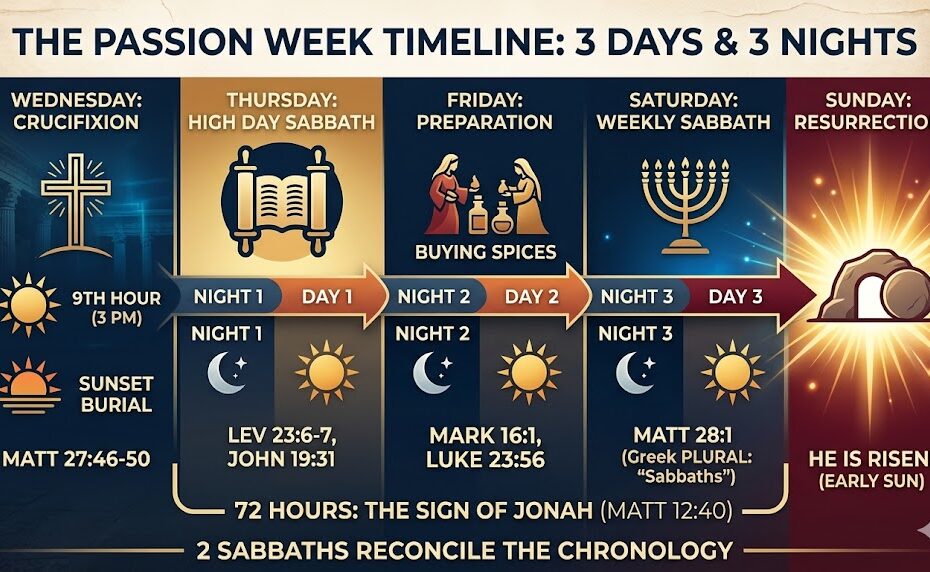
The Key: The “Two Sabbaths” — A little research Wednesday
The confusion often stems from not realizing there were two Sabbaths during the Passion Week:
-
The High Day Sabbath: The first day of Unleavened Bread (Leviticus 23:6-7). This can fall on any day of the week.
-
The Weekly Sabbath: The standard seventh-day Sabbath (Saturday).
Matthew 28:1 actually uses the plural Greek word Sabbaton, indicating that the women came to the tomb after the “Sabbaths” had passed.
The 72-Hour Timeline
Using the Jewish reckoning of time—where the calendar day starts at sunset and the “hours” are counted from sunrise—here is the chronological breakdown.
Wednesday: The Day of Sacrifice
-
The 3rd Hour (9:00 AM): Christ is crucified.
-
The 6th Hour (12:00 PM): Darkness covers the land (Luke 23:44).
-
The 9th Hour (3:00 PM): Christ cries out and dies (Matthew 27:46).
-
Sunset (6:00 PM): Christ is placed in the tomb just as the High Day Sabbath begins.
The Three Days and Three Nights
| Period | Day/Night | Biblical Context |
| Wed. Sunset – Thu. Sunrise | Night 1 | Christ in the tomb; The High Day begins. |
| Thu. Sunrise – Thu. Sunset | Day 1 | The High Day Sabbath (John 19:31). |
| Thu. Sunset – Fri. Sunrise | Night 2 | The High Day ends. |
| Fri. Sunrise – Fri. Sunset | Day 2 | The “Interim” Day. The women buy and prepare spices (Mark 16:1). |
| Fri. Sunset – Sat. Sunrise | Night 3 | The Weekly Sabbath begins. |
| Sat. Sunrise – Sat. Sunset | Day 3 | The Weekly Sabbath. Christ rests in the tomb. |
The Resurrection
-
Saturday at Sunset: As the 72nd hour concludes, Christ rises from the dead.
-
Sunday Morning: When the women arrive at the tomb “while it was yet dark,” the tomb is already empty (John 20:1).
Why This Matters
By acknowledging the Wednesday Crucifixion, we no longer have to “spiritualize” the three days and three nights. It allows for a literal fulfillment of prophecy:
“For as Jonah was three days and three nights in the belly of the great fish, so will the Son of Man be three days and three nights in the heart of the earth.” — Matthew 12:40
This timeline preserves the integrity of the scriptures, the specific requirements of the Law, and the precision of the 9th-hour sacrifice.
The Sunset Transition
In the Jewish calendar, Sunset is the “border” between two days. * Saturday 3:00 PM (The 9th Hour): This is the precise 72-hour mark from the 9th-hour death on Wednesday. At this moment, it is still the Weekly Sabbath.
-
Saturday 5:59 PM: The final moments of the Weekly Sabbath.
-
Saturday 6:00 PM (Sunset): The Weekly Sabbath ends. Sunday (the first day of the week) begins.
The Resurrection Window
To stay true to the “3 days and 3 nights” without “creeping” into the next day’s daylight, the resurrection would logically occur:
-
Late Saturday Afternoon: Between the 9th hour (3:00 PM) and Sunset (6:00 PM). This fulfills the 72 hours while remaining within the “Third Day.”
-
At the “Turn” of the Day: Right as the Sabbath ended and Sunday began.
In Matthew 28:1, it says: “In the end of the sabbath, as it began to dawn toward the first day of the week…” The Greek word for “dawn” here (epiphosko) can mean the beginning of the 24-hour day (which for Jews is sunset), not necessarily the sunrise. This supports the idea that as the Sabbath was “fading out” and Sunday was “fading in” at sunset, the tomb was already being vacated.
The 72-Hour Conclusion
Christ died at the 9th hour (3:00 PM) on Wednesday. To fulfill the Sign of Jonah exactly, the 72 hours concluded at the 9th hour (3:00 PM) on Saturday. This means He rose in the late afternoon of the Sabbath, shortly before the sun set to begin the first day of the week (Sunday). This is why, when the women arrived at sunrise on Sunday, He had been gone for hours!
FAQ:
The “High Day” Defense: When people say, “But the Bible says He died the day before the Sabbath,” point them to John 19:31. It explicitly states that Sabbath was a “high day” (Passover/Unleavened Bread), not necessarily the weekly Saturday Sabbath.
The “Three Days” Logic: Ask the critics: “How do you get three nights between Friday evening and Sunday morning?” (Traditional Friday-to-Sunday only has two nights: Friday night and Saturday night). The math only works with a Wednesday or Thursday start.
The Greek Plural: Remind them that Matthew 28:1 in the original Greek uses Sabbaton (plural), which implies the end of a sequence of Sabbaths.