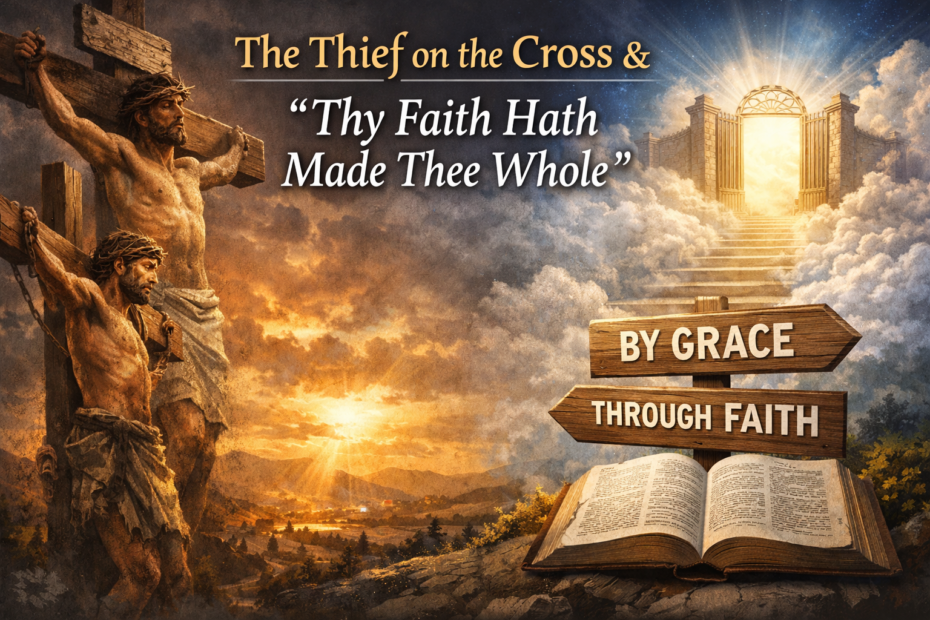
The Thief on the Cross and “Thy Faith Hath Made Thee Whole”
For those of us who hold firmly to the Bible’s teaching that salvation is by grace through faith, plus nothing and minus nothing, the Gospels contain several powerful confirmations of that truth.
One of the most overlooked patterns appears in the miracles of Jesus. On multiple occasions when Christ healed someone, He made a statement that deserves careful attention:
“Thy faith hath made thee whole.”
There were no additional requirements attached to that declaration. No ritual was added. No religious work was required. The person simply believed, and Christ responded to that faith.
Faith and the Miracles of Christ
Several times in the Gospels, Jesus connected healing directly to faith.
“And he said to the woman, Thy faith hath saved thee; go in peace.”
— Luke 7:50 (KJV)
“Receive thy sight: thy faith hath saved thee.”
— Luke 18:42 (KJV)
“Daughter, thy faith hath made thee whole; go in peace.”
— Mark 5:34 (KJV)
In each of these moments, Jesus identified faith as the determining factor. The people who came to Him believed that He had the authority and power to save or heal, and Christ acknowledged that faith. Foreknowledge
Notice something else that is equally important: no additional strings were attached.
Christ did not say, “Your faith has made you whole, but now you must complete a ritual for it to count.” He simply acknowledged their faith and granted what they sought.
This pattern reflects the same principle later explained clearly by the apostle Paul:
“For by grace are ye saved through faith; and that not of yourselves: it is the gift of God:
Not of works, lest any man should boast.”
— Ephesians 2:8–9 (KJV)
Grace is the source.
Faith is the means.
Works are not the cause.
The Thief on the Cross
Perhaps the clearest illustration of this principle occurs at the crucifixion.
Luke records the exchange between Jesus and one of the criminals being executed beside Him.
“And he said unto Jesus, Lord, remember me when thou comest into thy kingdom.
And Jesus said unto him, Verily I say unto thee, To day shalt thou be with me in paradise.”
— Luke 23:42–43 (KJV)
In those final moments, the thief demonstrated several things.
First, he acknowledged his guilt.
“And we indeed justly; for we receive the due reward of our deeds.”
— Luke 23:41
Second, he recognized the innocence of Christ.
“But this man hath done nothing amiss.”
Third, he expressed faith that Jesus truly was a King with a coming kingdom.
“Lord, remember me when thou comest into thy kingdom.”
This was not a complex theological statement. It was a simple expression of faith directed toward the Savior beside him.
And Jesus answered with a promise of eternal life.
What the Thief Could Not Do
The significance of this moment becomes clearer when we consider what the thief could not do.
He could not be baptized.
He could not perform works of righteousness.
He could not join a church or begin a life of discipleship.
His life was ending within hours.
Yet Jesus said plainly:
“To day shalt thou be with me in paradise.”
If salvation depended upon works, rituals, or ordinances, the thief could not have received that promise. But salvation was granted because of faith.
Just as in the miracles of Christ, the determining factor was belief.
Paradise and Christ’s Victory
Jesus promised the thief that he would be with Him in paradise that very day. Scripture also gives us a glimpse of what occurred after the crucifixion.
Paul later writes:
“Wherefore he saith, When he ascended up on high, he led captivity captive…”
— Ephesians 4:8 (KJV)
Many understand this to mean that before the resurrection, the righteous dead were in a place often called Paradise or Abraham’s bosom. After Christ completed His redemptive work and rose from the dead, He brought those redeemed into heaven with Him.
Whether one studies that view in detail or simply rests in the words of Christ, the conclusion remains the same: the thief died in faith and entered eternity saved.
The Same Gospel Today
The pattern seen in the miracles of Jesus and in the account of the thief on the cross points to the same truth repeated throughout the New Testament.
Salvation is not earned through works or religious activity. It is received through faith in the Savior.
A person hears the truth, recognizes their sin, and believes in the Lord Jesus Christ.
Just like the woman who touched the hem of His garment.
Just like the blind man who cried out for mercy.
And just like the dying thief beside the cross.
All three heard the same words from Christ in different ways:
Faith was the turning point.
And salvation has always been, and will always be, by grace through faith in Jesus Christ alone. Salvation