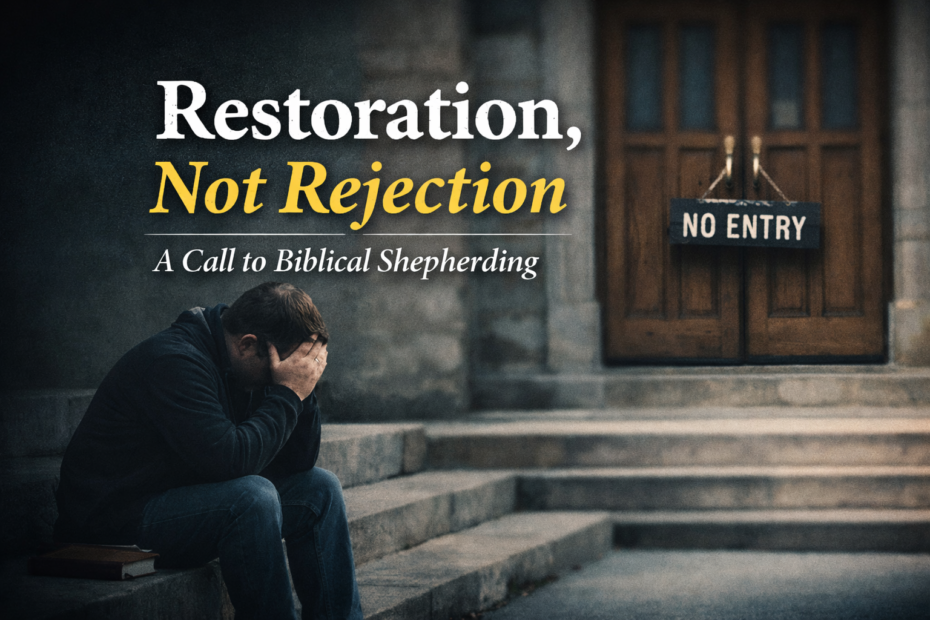
Restoration, Not Rejection: A Call to Biblical Shepherding
I love the church—because Christ loved the church and gave Himself for it (Ephesians 5:25). That love compels me to speak when something within the church is broken.
There is a troubling pattern within parts of the Independent Fundamental Baptist movement: the rejection of believers who have gone through divorce, often at the very moment they are seeking help, counsel, and restoration.
This is not theoretical. It is happening to real people.
A Real-Life Example We Cannot Ignore
I personally know of a family who walked through the devastation of divorce and did exactly what we tell hurting people to do—they reached out to their pastor for help.
The response they received was not counsel.
It was not restoration.
It was not patience.
They were told, plainly, to leave and not come back.
Wounded and confused, they sought refuge in another church, hoping for a different outcome. Instead, they were met with reluctance: “I don’t want to counsel you—but I will.” What followed was a rigid list of scheduling demands, a harsh spirit, and an unmistakable absence of compassion.
No warmth.
No burden-bearing.
No evidence of Christlike shepherding.
This is not an isolated story. It is becoming a pattern—and it is damaging the flock.
The Biblical Mandate We Are Ignoring
Galatians 6:1 gives clear instruction:
“Brethren, if a man be overtaken in a fault, ye which are spiritual, restore such an one in the spirit of meekness…”
The command is not avoidance.
The command is not dismissal.
The command is restoration, and it must be done with meekness.
When pastors refuse to counsel, create unnecessary barriers, or push wounded families out of the fellowship, they are not protecting holiness—they are abandoning their shepherding role.
A Double Standard That Damages the Flock
Many churches hold divorced believers under intense scrutiny while allowing pastoral indiscretions—pride, harshness, lack of compassion, or an unwillingness to shepherd difficult situations—to go unaddressed.
The qualifications for pastors in 1 Timothy 3 and Titus 1 are written in the present tense. They describe ongoing character, not past achievements. Accountability is not optional for leadership; it is essential.
A church that disciplines selectively will eventually lose moral authority altogether.
God’s Own Example of Mercy
In Jeremiah 3, God describes His dealings with Israel using the language of separation and divorcement—yet the chapter is saturated with His call to repentance and restoration.
“Return, thou backsliding Israel, saith the LORD…” (Jeremiah 3:12)
God addresses sin honestly, but He does not abandon His people permanently. If the Lord Himself models justice tempered with mercy, how can His church justify permanent rejection of repentant believers?
This Must Change
Divorce is painful.
It is disruptive.
It is serious.
But it is not beyond the reach of grace.
Churches must stop treating divorced believers as liabilities instead of souls.
Pastors must stop avoiding messy ministry.
And the body of Christ must recover the courage to restore rather than reject.
A Watchman’s Appeal
This is not written in anger alone, but in responsibility.
Silence helps no one.
Truth spoken in conscience is an act of love.
If the church is to reflect Christ, then it must look like Him—full of truth and grace.
“He restoreth my soul…” (Psalm 23:3)
May we do the same.