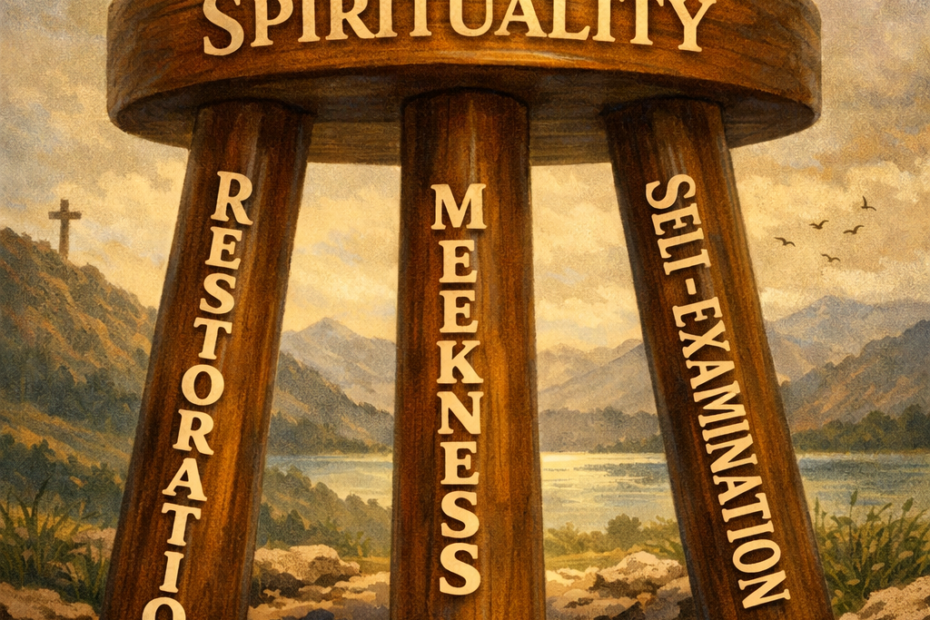
The Scaffolding of a Spiritual Life: The 3-Legged Chair
In Galatians 6:1, the Apostle Paul provides a blueprint for what it actually means to be “spiritual.” It isn’t a vague feeling or a high-minded state of being; it is a functional structure built on three interconnected necessities.
Think of “Spirituality” as the seat of a chair. For that seat to hold any weight, it must be supported by three specific legs. If you kick even one of them away, the entire claim to spirituality collapses.
“Brethren, if a man be overtaken in a fault, ye which are spiritual, restore such an one in the spirit of meekness; considering thyself, lest thou also be tempted.” — Galatians 6:1
1. The Leg of Restoration (The Goal)
True spirituality is never isolated; it is communal. The primary “output” of a spiritual person is the desire to restore a brother or sister. Without this leg, faith becomes a form of Judgmental Isolation. You might be “right,” but you are useless to the Body of Christ. Restoration proves that your faith is externalized—it’s about healing, not just highlighting faults.
2. The Leg of Meekness (The Method)
How you restore matters as much as the restoration itself. Paul calls for a “spirit of meekness.” Without this leg, restoration becomes condescension. If you try to help someone without a gentle spirit, you aren’t “spiritual”—you’re a “pious prosecutor.” Meekness is the lubricant that allows the truth to be received rather than rejected.
3. The Leg of Self-Examination (The Safeguard)
The final command is to “consider thyself.” This is the leg that prevents Hypocrisy. The moment you think you are immune to the very fault you are correcting in another, you have lost your footing. Self-examination turns a vertical hierarchy (looking down on someone) into a horizontal brotherhood (helping someone up while knowing you could just as easily be in the dirt).
| Missing Leg | The Resulting “Broken” Chair |
|---|---|
| No Restoration | Isolation: Humble and self-aware, but you leave your brother in the ditch. |
| No Meekness | Legalism: You try to “fix” people, but your harshness crushes them. |
| No Self-Examination | Hypocrisy: You are gentle and helpful, but blind to your own sin. |
Why They Are Interconnected
You cannot claim one of these truths while discarding the others.
- Can you be truly MEEK without SELF-EXAMINATION? No. Because without honest scrutiny of your own heart, a “gentle” tone is just a mask for hidden pride. You cannot be truly lowly if you aren’t aware of your own capacity to fall.
- Can you truly RESTORE someone without MEEKNESS? No. Without a gentle spirit, “restoration” becomes an intervention of force. Instead of resetting a bone so it can heal, you end up fracturing the person further with your harshness.
- Can you truly EXAMINE YOURSELF without the intent to RESTORE? No. Without the goal of helping others, self-examination becomes morbid introspection. You become a person staring in a mirror, obsessed with your own holiness or failures, while your brother remains in the ditch.
The Verdict: Restoration proves the work is external. Meekness proves the work is humble. Self-examination proves the work is honest.
True Christianity requires all three. It is a “check and balance” system for the soul that ensures we remain active, humble, and honest.